




After several weeks of playing and taking the Donner HLX-500 to a gig, Harkus found that the headless design made the guitar easier to handle and tune without taking away the familiar sounds he wanted on stage. His review explains what the compact shape changes in practice, how the bridge handles restringing and tuning, and why he found himself reaching for this guitar at home as well as for live work.
Donner HLX-500 Headless Electric Guitar

The Donner HLX-500 Headless Electric Guitar combines a full-scale neck and fixed bridge with two single coils and a bridge humbucker. A five-way selector gives you access to the pickup combinations, and the bridge-mounted tuners keep the headless design compact enough to take from home practice to a gig.
Why the headless design matters
Harkus had used a wide leather strap to manage the balance of his Telecasters, so the supplied nylon strap was a useful comparison. On the Donner HLX-500, he found it comfortable even without the extra width and weight. The shorter outline also gave him more room beside the bass player on a tight stage and made the guitar easier to pick up on the sofa. That same reduction in size leaves more space for other gear in the car.
With the Donner HLX-500, the strings clamp at the neck end and tune at the bridge. For Harkus, that arrangement means fewer opportunities for the strings to slip and less spare string to stretch when fitting a new set. Having gigged with the guitar, he cared more about whether it held its tuning through bends than whether the design looked familiar.
Hardware and controls
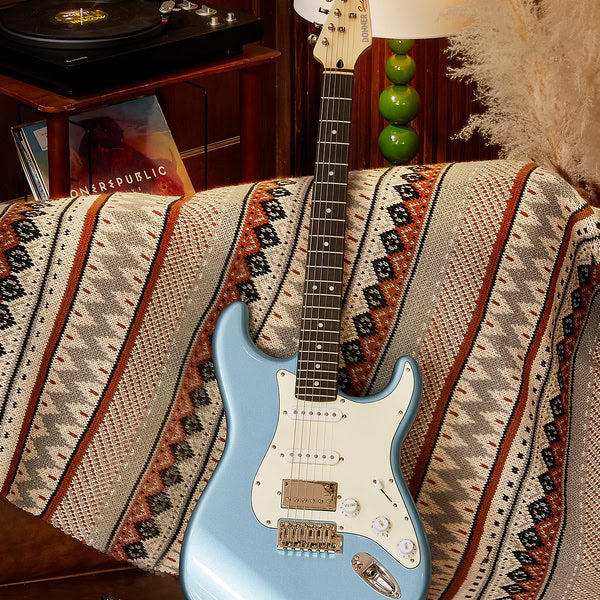
Harkus chose the Sherwood Green Donner HLX-500. He liked the even finish and its hint of sparkle against the black hardware and roasted maple neck. He put the weight at approximately 2.4 kg. Just as important to him was how well the guitar balanced, rather than weight alone.
Each string on the Donner HLX-500 is held by two hex fasteners at the neck end. Harkus liked having a second point of contact under tension, as well as a guard that keeps protruding string ends away from his fingers and lets him feed the string through before trimming. The bridge felt closer to a Strat to him than the silhouette suggested. Strings feed in from behind, and conventional-style saddles set height and intonation. The difference is where he tunes: small wheels behind the bridge adjust the tension at the strings’ anchor points.

Donner HLX-500 Headless Electric Guitar Review. The Blogging Musician @ adamharkus.com. Double-locking nut
On the Donner HLX-500, Harkus could reach the volume knob with his little finger for swells without feeling crowded by the other controls. The downward-facing jack let him run a lead under the strap or tuck a wireless transmitter out of the way. Adjusting neck relief was similarly straightforward for him: the wheel is accessible at the heel, and the supplied tool lets him turn the dual-action rod in either direction.
Harkus also appreciated that the Donner HLX-500 pairs a bone nut with a zero fret. He points to the zero fret as a way to set string height at the neck end and make the transition between open and fretted notes feel more consistent.

Donner HLX-500 Headless Electric Guitar Review. The Blogging Musician @ adamharkus.com. Sturdy controls
Playability and fret access
Before plugging in, Harkus wanted to know whether the Donner HLX-500 was as comfortable to play as it was to hold. Although the 25.5-inch scale felt familiar, he found the matte roasted maple neck a little fuller than a modern C profile. With extra room at the edges of the fretboard, the outer strings did not feel as if they might slip off. For Harkus, the shape worked for both chords and lead playing as the neck filled out towards the heel. The recessed heel and cutaways let him reach all 24 frets without having to work around the neck joint.
Donner HLX-500 Headless Electric Guitar Review. The Blogging Musician @ adamharkus.com. Roasted maple neck
On his Donner HLX-500, Harkus brought the high E down to about 1.25 mm at the twelfth fret, his preferred action. He polished the frets and oiled the fingerboard, but reckoned he could have taken the guitar to a gig as it came. In his playing, the Donner HLX-500 held its tuning through large bends. The neck and string spacing that he had liked on first inspection also made sustained chord work comfortable, while fast legato felt easy.
Donner HLX-500 Headless Electric Guitar Review. The Blogging Musician @ adamharkus.com. Sculpted heel.
String changes and tuning
The Donner HLX-500 takes standard strings, so Harkus did not need a special double-ball set. He starts by backing off the bridge thumbwheel until the opening lines up with the saddle. The string then goes in from the rear: pulling it taut seats the ball end, while a 2 mm Allen key secures the other end at the neck. Once it is clamped, he brings it to pitch at the bridge.
Restringing the Donner HLX-500 took a little practice. Once Harkus knew the sequence, he found it quicker than changing strings with conventional tuning machines, partly because there was less excess length to stretch in. A string can still catch as it passes through at the saddle or nut. That is where the supplied flexible tubes come in: they give the string a path through if it does not feed cleanly on its own.
Classic tones from the SSH pickup layout
Harkus heard familiar Strat-style sounds from the Donner HLX-500’s single coils. He found the neck pickup clean but full, the neck-and-middle combination thicker, and the middle pickup punchy enough for blues. The middle-and-bridge setting was his brighter choice for syncopated rhythm. The bridge humbucker gave him the extra midrange and sustain he wanted for heavier parts.
What mattered live was how those sounds worked together. Harkus could take the Donner HLX-500 from a bright rhythm sound to a neck-pickup solo or a fuller bridge sound without an awkward jump in level. That combination of familiar tones and less familiar hardware was the surprise of the review. He also liked the quick connectors on the direct-mounted pickups, which allow changes without soldering. His advice when choosing replacement single coils is to look for ones without mounting flanges.
How the Donner HLX-500 worked in daily use
After several weeks with the Donner HLX-500, including live use, Harkus found himself reaching for it when he wanted to play without much preparation. It stayed in tune for his practice, and the shape worked for him both seated and standing. The bridge tuners turned out to offer two advantages he had not expected: enough travel for larger pitch changes, and enough control for fine ones. With the tuning adjustments at the bridge, he did not have to keep moving his fretting hand away from the fingerboard.
For Harkus, the convenience of the Donner HLX-500 carried over to band work: a smaller bag to load and fewer adjustments to think about once the set started. He knew the look would not suit everyone, but after taking it to an ’80s gig, he saw no conflict between the modern design and the traditional sounds he needed. In the end, he rated the Donner HLX-500 as an electric guitar on its own merits, not just a good example of a headless design.
What the Package Adds
Part of the value Harkus saw in the Donner HLX-500 was what came with it: the padded bag, adjustable strap, setup tools, picks, string guides and spare fasteners covered much of what he needed. His point for a first-time buyer was practical: an amplifier is still needed, but several of the small items that would normally be separate purchases are already there.
Adam Harkus Donner HLX-500 Electric Guitar Review
Who should consider the Donner HLX-500?
The Donner HLX-500 is worth considering if you want a full-scale electric guitar that is easier to carry into a rehearsal or fit into a tight practice space. Harkus’s experience is particularly useful if you want those practical advantages but would rather keep familiar single-coil and humbucker sounds. You can see the model and available finishes on our UK product page.